
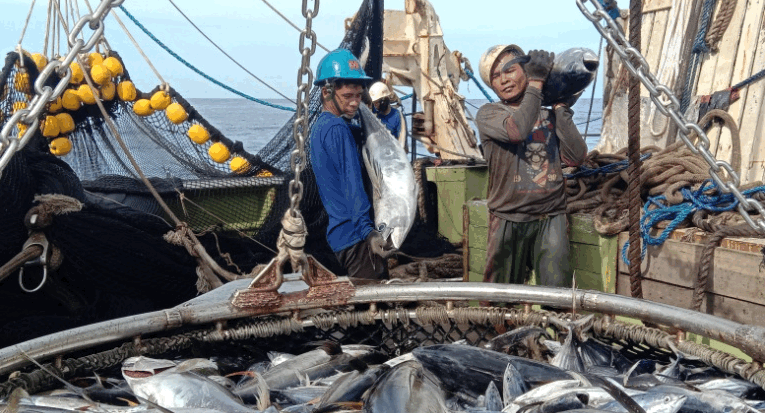
A decade-long journey from assessment to transparency leadership
When the Fishing Industry Association of Papua New Guinea began examining labor conditions across its operations in 2012, it faced a question that confronts every major fishing operation: how do you protect workers on vessels that spend months at sea, often thousands of miles from port?
Thirteen years later, FIA PNG—whose fleet accounts for 18% of global tuna catches—has arrived at an answer that challenges the industry’s traditional approach to worker welfare. Rather than treating social accountability as a compliance exercise, they’ve built what they call a “self-sustaining system” that combines real-time digital traceability, multiple verification layers, and operational transparency that extends to sharing vessel locations with the public.
These actions are laudable on their own – but they also highlight a larger opportunity, one at the heart of the Global Charter for Fisheries Transparency – that it is possible to improve human, sustainability and environmental outcomes globally when countries take initiatives aligned with global best practices in these areas.
The Evolution of an Approach
The journey began conventionally enough. In 2012, the Forum Fisheries Agency commissioned social accountability assessments of FIA PNG’s shore-based processing facilities using the SA8000 standard. By 2014, those facilities had achieved third-party certifications through BSCI and SEDEX/SMETA. These certifications involve “worker‑welfare checks” that sit alongside environmental and traceability standards, showing that PNG’s onshore factories are being scrutinised for human rights risks as well as for product quality.
But tuna fishing presents challenges that factory work doesn’t. Fishing vessels operate in isolation. Crew members may be at sea for extended periods. The physical distance from regulatory oversight creates inherent vulnerability—and opportunity for abuse, well documented in reports like this from the Environmental Justice Foundation.
FIA PNG’s response was to extend its shore-based systems offshore, but not through simple replication. Instead, they developed an integrated framework anchored by their Responsible Sourcing Policy, launched in 2018, which established social responsibility and crew welfare as one of its core pillars alongside marine stewardship certification, traceability, and marine litter management.
The implementation details reveal the substance behind the policy language:
Multiple verification layers: The organization employs internal audits by member companies, second-party audits by qualified FIA PNG auditors, and third-party certification audits. This isn’t redundant—it creates overlapping accountability that catches what any single system might miss.
Technology-enabled monitoring: Since 2022, FIA PNG has shared real-time vessel monitoring data with Global Fishing Watch, making vessel locations publicly visible. This seemingly simple transparency measure addresses a root cause of forced labor at sea: isolation. When vessels operate in full public view, the risk calculus changes fundamentally.
Embedded data requirements: In 2023, FIA PNG integrated Social Accountability Key Data Elements into its Fishing Industry Management System—requiring documentation of worker protections trip by trip, vessel by vessel. This moves social accountability from periodic audits to continuous operational data, the same way safety or catch data is tracked.
Government oversight integration: Papua New Guinea’s National Fisheries Authority maintains 100% observer coverage on all vessels and operates 24/7 vessel monitoring systems. The PNG government’s 2022 agreement to share vessel monitoring data with Global Fishing Watch in real time represented a significant commitment to transparency—making FIA PNG the only tuna fleet operating with this level of public visibility from 2022 through 2024.
What the Numbers Represent
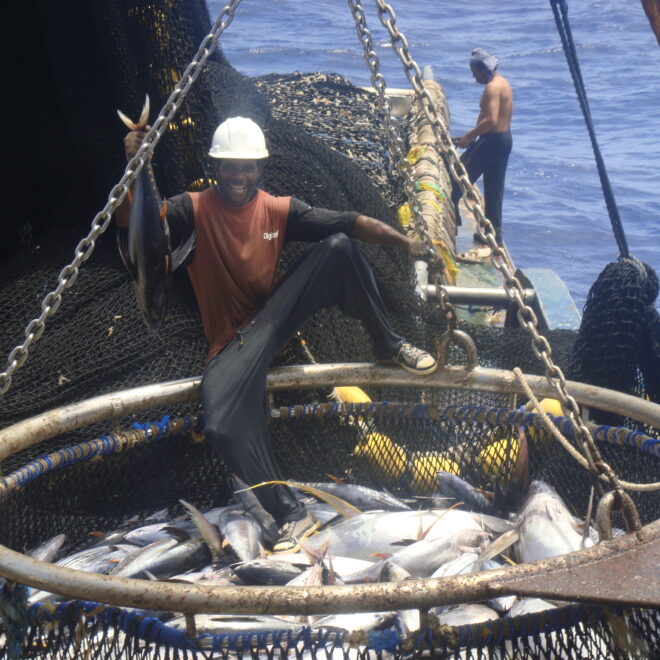
By 2022, 32 tuna purse seiners had achieved FISH (Fairness, Integrity, Safety, and Health) standard certification, directly impacting working conditions for more than 2,300 crew members. As of the current reporting period, 80% of the fleet has undergone combined internal, second-party, and third-party audits.
These figures matter not because they represent perfection—no system does—but because they demonstrate systematic implementation across a major fleet. This is scale that moves industry benchmarks.
The “No Silver Bullet” Principle
Perhaps the most significant aspect of FIA PNG’s approach is its explicit rejection of what they call “a single bullet solution.” Their Modern Slavery Statement deliberately positions worker protection as requiring multiple, reinforcing mechanisms:
- Government oversight (100% observer coverage and continuous vessel monitoring)
- Industry self-regulation (internal audit protocols and member screening)
- Third-party verification (FISH certification, MSC fishery certification)
- Digital traceability (the iFIMS system providing near real-time trip-by-trip monitoring)
- Operational transparency (public vessel tracking through Global Fishing Watch)
- Documented procedures (Social Accountability Key Data Elements embedded in operational systems)
No single element is sufficient. Together, they create what resilience theorists would call redundancy—when one system has gaps, others catch what falls through.
What This Means for Global Practice
FIA PNG’s trajectory from 2012 assessment to 2025 implementation offers several lessons for the broader industry:
First, meaningful worker protection requires operational integration, not compliance separation. When social accountability sits in a CSR department disconnected from fishing operations, it remains vulnerable to being deprioritized under operational pressure. When it’s embedded in trip-by-trip data requirements and operational systems, it becomes as routine as catch reporting.
Second, transparency creates accountability that audits alone cannot. Public vessel tracking through Global Fishing Watch gives external stakeholders—NGOs, researchers, consumers, competing operators—the ability to monitor behavior in ways that make purely performative commitments harder to sustain. FIA PNG describes being “the only Tuna Fleet” operating with this level of transparency from 2022 to 2024, positioning it as “frontline increasing the bar in the Global Tuna Industry.”
Third, technology enables what geography once prevented. Real-time data integration makes continuous monitoring feasible at a scale that periodic audits cannot achieve. Digital traceability systems transform social accountability from retrospective assessment to ongoing operational oversight.
Fourth, this work requires sustained commitment over years, not quarters. FIA PNG’s timeline spans more than a decade. The progression from initial assessments to integrated systems didn’t happen rapidly, and trying to compress the timeline would likely have produced superficial rather than systemic results.
Fifth, multiple standards and frameworks work together. FIA PNG’s social accountability procedures reference more than 20 different international standards, conventions, and guidelines—from ILO Convention 188 and the Maritime Labor Convention to the FISH standard and various certification schemes. Rather than choosing one framework, they’ve built a comprehensive approach that draws on multiple sources of best practice.
The Larger Context
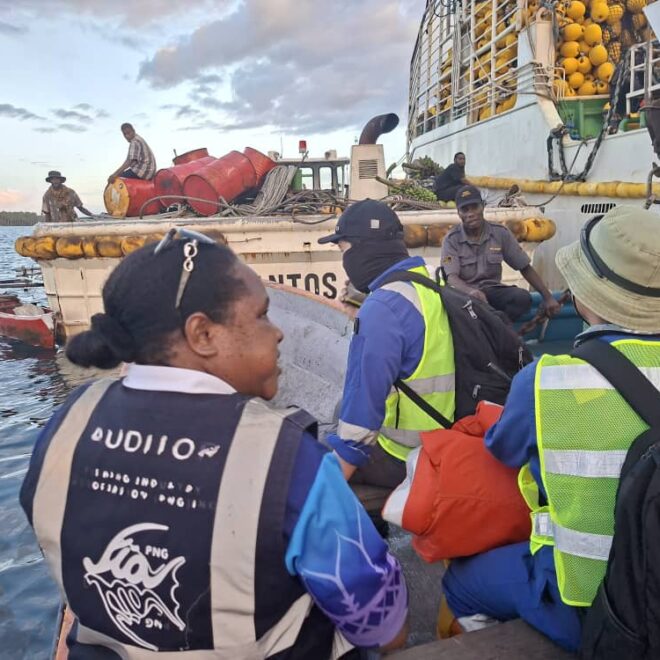
Forced labor and modern slavery in fishing remain urgent global challenges. According to various international estimates, hundreds of thousands of fishers work under conditions that meet the definition of forced labor. The geographic isolation, complex supply chains, and gaps in governance that characterize much of global fishing create persistent vulnerabilities.
What makes FIA PNG’s approach noteworthy isn’t that it has eliminated all risk—that would be overclaiming. Rather, it demonstrates that large-scale fishing operations can build systematic protections that make exploitation materially harder to sustain and easier to detect.
The test of any model isn’t perfection but whether it creates conditions where problems surface rather than remain hidden, where accountability is distributed rather than concentrated, and where protection mechanisms strengthen over time rather than atrophy.
By those measures, FIA PNG’s integrated approach offers a reference point for what’s possible when social accountability moves from policy aspiration to operational reality. Their commitment to public vessel tracking, embedded data systems, multiple audit layers, and continuous government oversight represents a comprehensive framework rather than a single intervention.
The journey from 2012’s initial assessments to 2025’s integrated systems demonstrates that transformation in this space is measured in years and requires coordination across government, industry, certification bodies, and technology platforms.
But it was achievable. And much more can be achieved by countries that want to improve our performance on labor, environmental and sustainability issues by using global standards and operating within the framework of the Global Charter for Fisheries Transparency.
Marcelo Hidalgo serves as Chief Operating Officer of the Fishing Industry Association of Papua New Guinea and sits on the Worker Voice Oversight Committee and the Steering Oversight Committee for the FISH Standard for Crew.